Models are struggling, and many are taking notice…
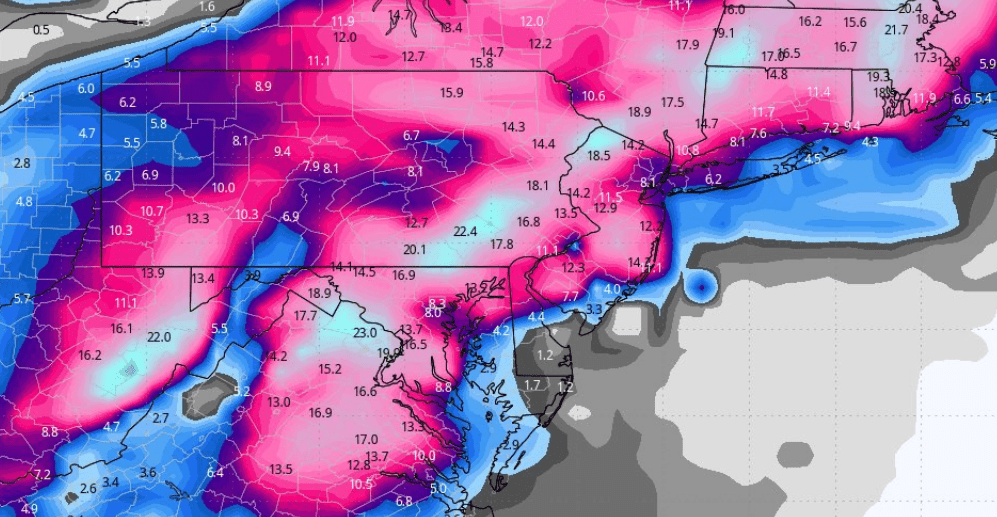
Meteorologists and weather enthusiasts alike are noticing some very inaccurate model forecasts of late, and it is getting more attention in the wintertime. These inaccuracies have been occurring prior to winter as most operational and consulting meteorologists who monitor models several times daily would admit. But the overwhelming amount of eyes on the models occurs in Winter. Why? It’s snow season. Or at least it should be. So far this month, there has been little to get excited about if you’re a snow lover. December was decent, but January, at least so far, not so much.
With that being said, many enthusiasts are noticing some wild storm solutions in the mid-range and long range, and as that period approaches a shorter-term range, a completely different solution is presented. It becomes very frustrating for anyone that tries to put together longer range forecasts as it relates to storms and storm signals. For this forecaster who takes a lot of pride in long range forecasting as one of my own personal strengths, this year has been quite challenging. Typically global observational data can provide some stability in predicting things like temperature patterns and longer term precipitation departures from average. But for synoptic events, you place a little more emphasis on model output, and monitor trends.
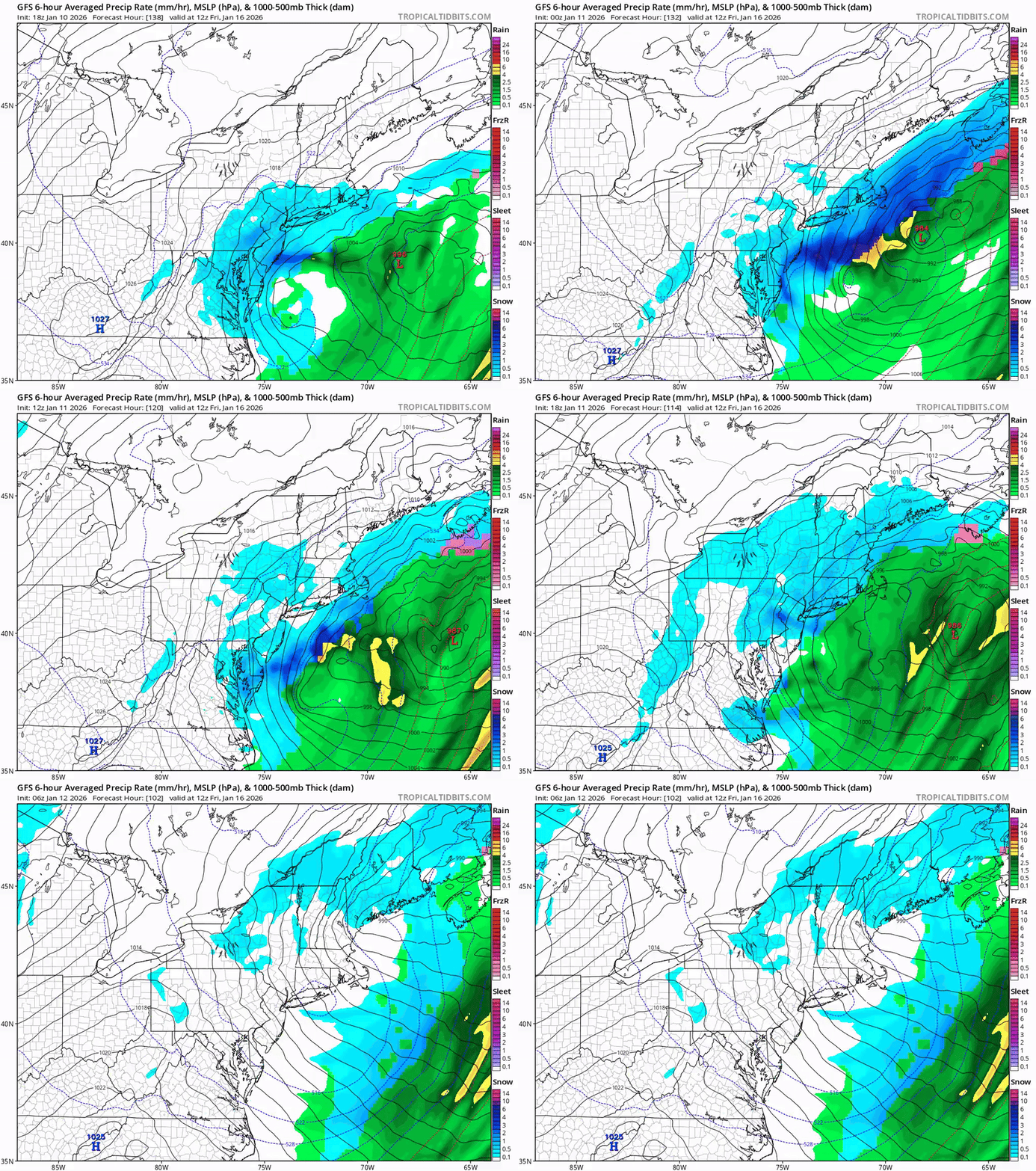
So what gives? Are the models getting worse? Are the model “upgrades” making them worse?
Short answer… no. Models are simulations of the future, and some are better historically than others. Some specialize in certain types of systems in specific time frames. Others are used for convection-allowing, tropical cyclones and hurricanes, and extended or seasonal forecasts. Each have their own limitations and biases, and those biases have been well documented. The upgrades, contrary to popular opinion, have been aimed at making them better. The upgrades have been implemented to just about all models across the board, and not just the American-based guidance. There have been updates to most models over time to fix bugs and tweak the algorithms to improve their performance. AI models (a machine learning tool) have been introduced within the past few years, and are also aimed at improving forecasts.
The way models work is they take in and ingest actual observed data from all levels of the atmosphere, and then simulate the future off of that with their own individual algorithms and parameters. The observed data collected serves ALL models, so it doesn’t matter if we’re talking about the GFS, the ECMWF (Euro), or any of a plethora of other models. They ALL use the same initialization data. That is to say, there is no “magic” model that will do better than another if there are key components missing of that data itself. And that brings us to the main issue… a fundamental lack of critical data and measurements.
How is data collected that feeds into the models?
Weather data for models is collected globally from diverse sources like satellites, radar, weather balloons (radiosondes), surface stations (ASOS, COOP), buoys, and aircraft, measuring temperature, pressure, wind, humidity, and precipitation, then fed into powerful computers that use physics equations to simulate and predict atmospheric changes.
Model Data Collection Methods:
- Surface Weather Stations: Automated Surface Observing Systems (ASOS) and Cooperative Observer Program (COOP) stations use sophisticated instruments to measure conditions at ground level.
- Radiosondes (weather balloons): Launched twice daily globally, these balloons carry instruments (radiosondes) to measure upper-air conditions (temperature, humidity, pressure, wind) as they ascend.
- Satellites: Provide broad-scale views, tracking large systems like hurricanes, smoke, and cloud cover, and measuring atmospheric properties from space.
- Doppler Radar: Detects precipitation and wind movement within storms, crucial for short-term forecasts.
- Aircraft: Commercial planes provide automated reports (AMDAR) on temperature, wind, and turbulence as they fly.
- Ocean Buoys & Ships: Gather data from vast ocean areas, including sea temperature, wave height, and surface conditions.
- Wind Profilers: Ground-based radar systems that measure wind profiles in the upper atmosphere.
Weather models then take these billions of observations that are gathered daily from these interconnected global networks. The raw data is quality-controlled and assimilated into a coherent 3D picture of the atmosphere. Supercomputers divide the atmosphere into a grid, using mathematical equations (fluid dynamics, thermodynamics) to calculate how conditions will evolve at each grid point and at various resolutions, creating future forecasts.

While most global radiosondes continue to operate routinely, there have been changes to the U.S. National Weather Service radiosonde operations, which is likely affecting model performance in the United States. Some sites have ceased operations entirely, or in some cases, they are limited to a once-daily launch vs. the usual two.
What are radiosondes and how do they work?
A radiosonde is a small, battery-powered instrument package carried aloft by a weather balloon to measure atmospheric conditions like temperature, humidity, pressure, and wind (speed/direction) at different altitudes, transmitting this data back to ground stations for weather forecasting and atmospheric research. These expendable devices are key to understanding the upper atmosphere, with modern ones using GPS for precise wind tracking. A large latex balloon filled with helium or hydrogen lifts the radiosonde, which can reach over 100,000 feet AGL before bursting. Data is sent in real-time (often every second) back to Earth, and ingested into the supercomputers that run simulations of the future as it relates to forecasts.

Photo courtesy: U.S. National Weather Service
A Growing Concern in U.S. Weather Forecasting Capabilities
In recent months, deep federal budget cuts to the National Oceanic and Atmospheric Administration (NOAA) — including significant reductions at the National Weather Service (NWS) — have alarmed scientists, former agency leaders, and meteorologists. These cuts, proposed and enacted under the current federal budget framework, are not just administrative decisions; they have real, measurable impacts on how atmospheric data are collected, how forecast models are run, and how communities prepare for severe weather. This has led to a suspension or scaling back of twice-daily weather balloon launches in many regions.
“Without these observations, models have less real-time data to “ingest.” There is an old saying in meteorology… “garbage in, garbage out.” If the input data are sparse or missing, the model forecasts will then become less reliable.”
Direct Impacts on Forecast Models
Forecast models depend heavily on real-time observations and continuous scientific improvement. Weather models begin with a “snapshot” of the current atmosphere. This initial state is constructed from observations — satellites, balloons, radar, buoys, aircraft dropsondes, and surface stations. When these inputs are reduced:
- Forecast uncertainty increases, especially for severe weather events.
- Hurricane track and intensity forecasts degrade, because upper-air data are critical for storm dynamics.
- A reduction in NWS balloon launches will degrade not just public NWS models and their accuracy, but even private sector forecasts that rely on the same data streams, including EPAWA
Why is this important to EPAWA and why do we care?
Our reputation in the industry for accurate forecasts without the hype and doomsday stuff, as well as full transparency in all of our forecasts and discussions has been a staple of EPAWA since inception in 2010. To the common observer, a changing day to day forecast, or an abrupt change in our Friday (weekly) long range outlook may appear like we’re slipping, or that we’re no better than the next weather outlet. We are in essence handcuffed by the same forecast data that the National Weather Service uses, and have often times found that we are analyzing data that is skewed or off – leading to different downstream outcomes and results. We are “weathering the storm” until a time where accurate observational data is fully integrated once again. But don’t blame the models… blame the lack of funding in this case which has ultimately led us to this outcome.
Budget cuts to the National Weather Service and NOAA are more than administrative austerity measures. They strike at the heart of weather prediction: observational data, scientific research, and expert staffing. Without robust model guidance, the nation’s ability to anticipate and respond to weather hazards is weakened — with consequences that extend from individual safety to national economic resilience. This is true for our private consulting operations as well.

What can we all do to help?
1. Engage Elected Officials
- Call or write members of Congress to express support for full funding of NOAA and the National Weather Service.
- Emphasize that weather forecasting is public safety infrastructure, not discretionary science.
2. Push Back Against “Private Sector Will Replace NWS” Narratives
- Many private weather companies depend on NWS and NOAA data, including EPAWA.
- Without public observations and models, private forecasts degrade as well.
- Encourage media outlets to clarify that private forecasting does not replace public data collection.
3. Raise Public Awareness
- Share credible reporting on NWS staffing shortages and reduced observations.
- Correct misinformation on social media.
- Encourage local media to interview NWS meteorologists and emergency managers.
This article is meant to be informative. It is in NO WAY political or taking a political stance, rather setting the record straight of what is actually happening. We are separating the false narrative that “forecasters and models are getting worse” from the actual reason these forecasts are seemingly degrading. We are doing our best as we always do, but patience and understanding will go a long way to those that dedicate tireless hours of work to assist their clients in make safe and informed choices. Like I said in the Monday morning (1/12) video forecast, if you are roofer and have all of your equipment, nail gun, safety harness, etc. to lay shingles on a roof… and no nails… your job is severely impacted. In addition to actual observational data, models are tools that we as meteorologists use to make the forecasts, most notably upper air soundings. If the ingested/input data is skewed or partially missing, it makes that job we do that much more difficult.
Thanks for reading!